Today’s focus is the 4 Party Model, which shows how transactions move from buyer to seller.
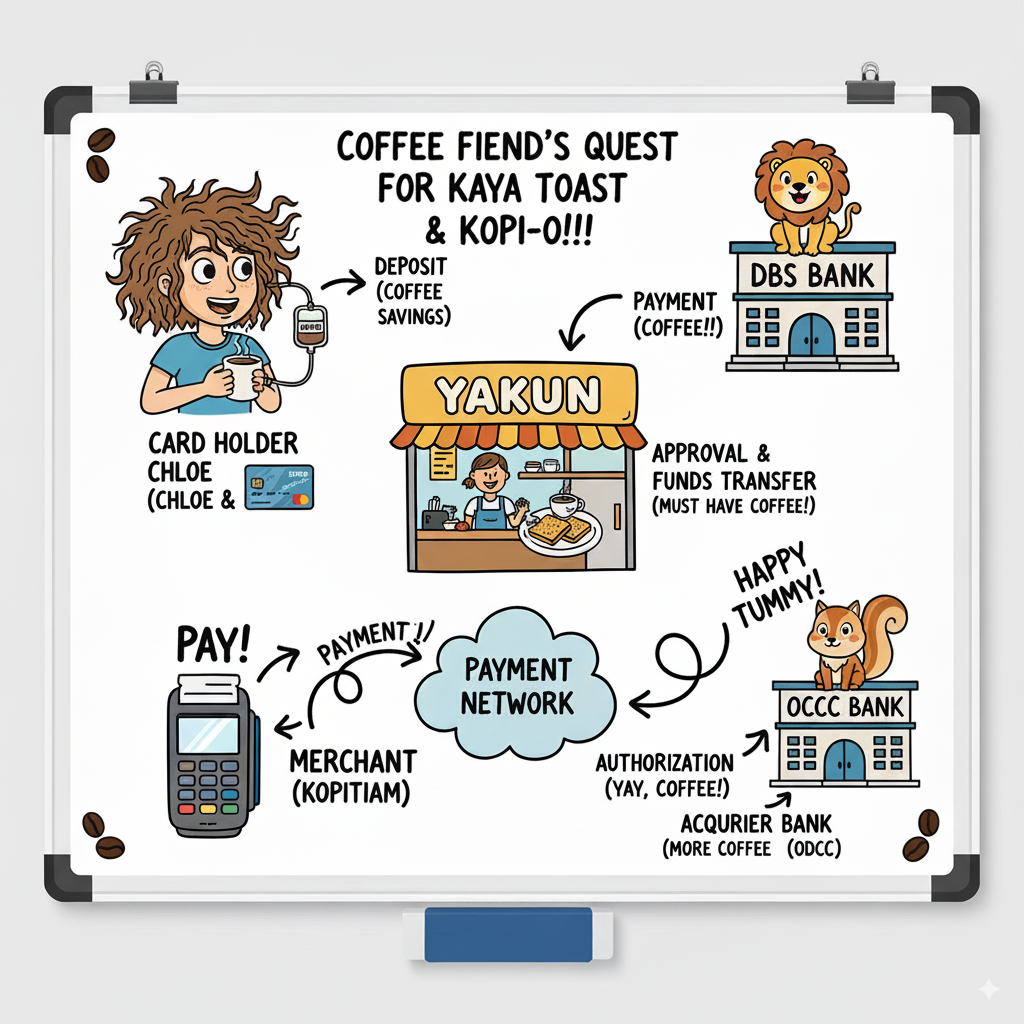
The best analogy (in Singapore) is buying coffee from Yakun — because Yakun > BreadTalk — so let’s use this familiar experience to break down the 4 Party Model!
The 4 Players
When buying Yakun coffee, think of these 4 stakeholders:
- You
Sleep-deprived, surviving on coffee. - Yakun
A business built on caffeinated history (pun intended). - Your Bank
Example: DBS. - Yakun’s Bank
Example: OCBC.
How the 4 Party Model Works
Here’s the simplified flow:
-
Card Tap
When you tap your card at the POS Machine, your card details are sent from Yakun’s point-of-sale terminal. -
Network Transfer
The POS sends your information to the Payment Networks (Visa, Mastercard, etc.). The network encrypts and forwards it to Yakun’s bank (OCBC), which then routes it back to DBS. -
Approval Process
DBS checks your card status, account balance, and flagging for potential fraud. Once verified, it sends an authorization signal back to the POS terminal. -
Receipt
The POS terminal prints a receipt and the transaction completes.
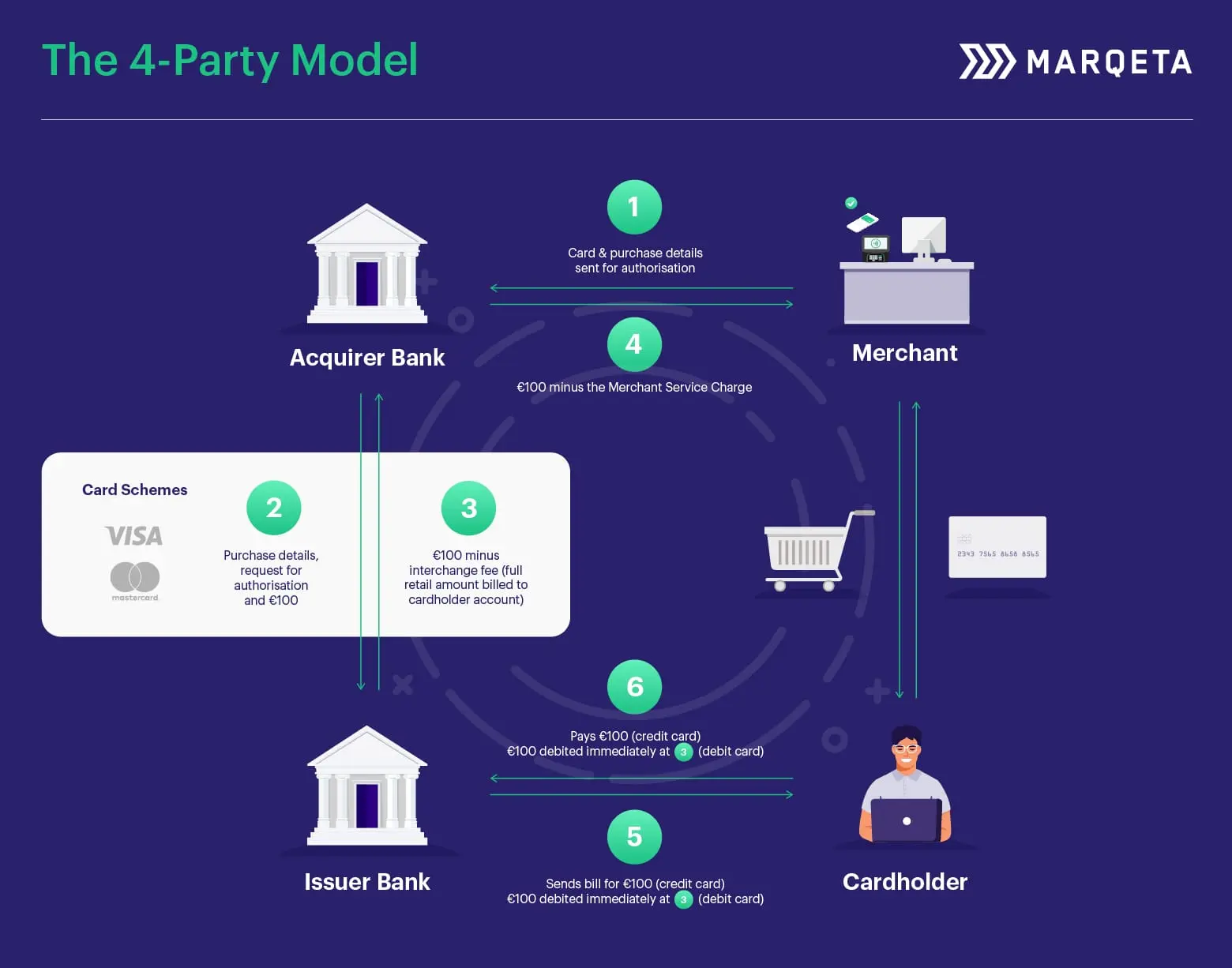
This entire sequence is known as the Authorization Flow.
The 3 Key Processes
Each transaction involves three main processes:
| Process | What Happens |
|---|---|
| Authorisation | Checks if transaction is possible |
| Clearing | Exchanges detailed transaction data |
| Settlement | Actually moves money between banks |
You, as the consumer, generally only see the Authorisation process. Card declines happen here!
Digging Deeper: Process Details
Authorisation Flow
(Similar to above)
- Tap card at Yakun.
- OCBC sends authorisation request to Visa. (This request is packed with message codes: think “secret language”).
- Visa forwards it to DBS.
- DBS verifies:
- Card is active
- Account has sufficient balance
- No fraud alerts (e.g. can’t be in China and India at the same time)
- DBS approves and sends code back via Visa/Mastercard to OCBC, and finally, to Yakun’s POS terminal.
Clearing
Typically happens in batches at day’s end.
- Yakun sends all approved transactions to OCBC.
- OCBC formats and sends them to Visa/Mastercard; this is a CLEARING file.
- Visa/Mastercard forwards the data to DBS.
- DBS records the transactions.
Note: The money hasn’t left the bank yet!
Settlement
This is when the money moves:
- Visa calculates net amounts owed (like figuring out Splitwise IOUs).
- DBS transfers $5 to Visa’s settlement account.
- Visa passes funds to OCBC, after deducting network fees.
- OCBC deposits the final amount into Yakun’s account.
How Banks & Networks Profit
- Both Visa/Mastercard and the banks take a small fee — think “gas fees” from Crypto/Web3.
- There are other revenue streams, but transaction fees are the most visible.